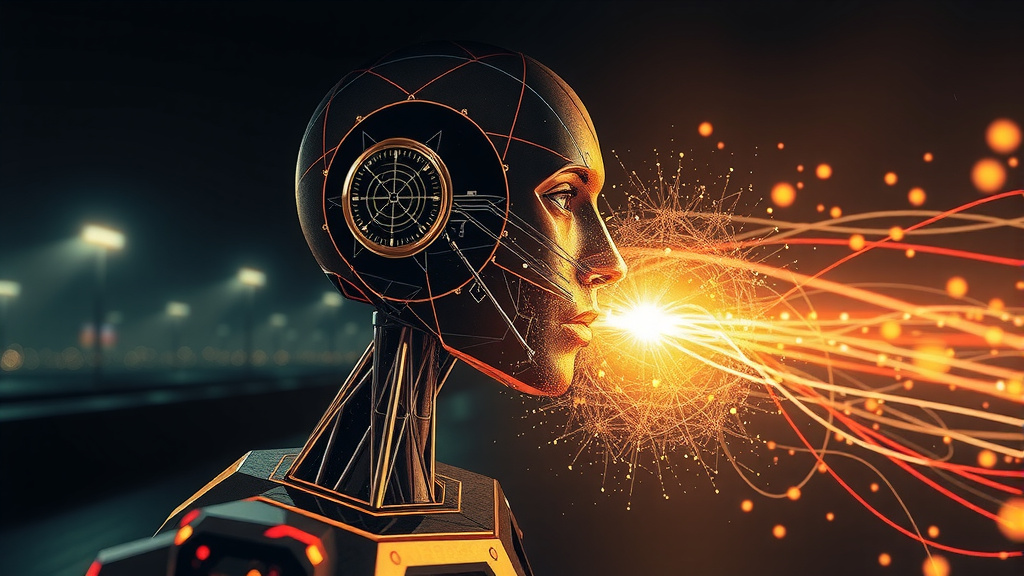
While everyone is arguing about which LLM writes better marketing copy, a quieter class of AI is stabilizing 100-million-degree nuclear plasma in real time — and almost nobody in tech is paying attention.
I’ve been thinking about this for a while, and I keep coming back to a simple distinction that I don’t hear discussed enough: there’s a fundamental difference between AI that learns the statistical shape of human language and AI that learns the actual structure of physical reality. Both are impressive. Only one of them is building a moat that can’t be copied.
The Language of Thermodynamics Doesn’t Have Synonyms
When DeepMind’s team trained a reinforcement learning agent to control the plasma in a tokamak fusion reactor, they weren’t doing prompt engineering. They weren’t fine-tuning on feedback from a human rater. They were optimizing against the universe itself — against differential equations that don’t care about your feelings, your training data quality, or your benchmark score.
The plasma either stays confined or it doesn’t. The magnetic coils either compensate correctly or the experiment ends in a fraction of a second. There is no hallucination budget. There is no “mostly right.”
This is categorically different from what language models do. I want to be fair here — LLMs are genuinely remarkable, and I use them constantly. But the thing they’re good at is approximating human expression, which means they inherit all the fuzziness of human expression. You can get away with a lot of fuzz in language. People are forgiving. Context fills gaps. A slightly wrong word rarely causes a catastrophic failure.
Thermodynamics is not forgiving. Neither is protein folding. Neither is the control loop for a hypersonic vehicle or the optimization of a particle accelerator beamline.
The Moat Is Physics, Not Parameters
Here’s the economic argument that I think gets missed: the companies building AI on top of physical law are accumulating a kind of knowledge that can’t be transferred through fine-tuning.
If a competitor wants to match GPT-4 on coding benchmarks, they can assemble a dataset, run some RLHF, and get surprisingly close. The knowledge lives in the weights, yes, but the recipe for building those weights is increasingly understood. Language is a domain where the inputs and outputs are human-readable, which means anyone with compute and data can participate. The feedback signal is cheap.
The feedback signal for fusion plasma control is not cheap. You need the reactor. You need the years of operational data. You need the domain scientists who understand what “good” actually looks like at 150 million degrees Celsius. You need the closed-loop training runs that take real time in the real world. That’s not a dataset problem you can scrape your way out of.
In my experience building software products, the deepest moats come not from secrecy but from accumulated time in domain. A company that has been running a physical AI system in production for three years doesn’t just have better weights — they have a feedback loop that took three years to build. That compounds in ways that are very hard to replicate by throwing money at it.
What This Means for the Decade Ahead
I’m not arguing that language models don’t matter — they’re eating software and I expect that to continue. But I do think the hierarchy of economic value is going to look different than the current discourse suggests.
The companies that will hold the deepest positions in ten years are probably not the ones with the best chatbots. They’re the ones that successfully embedded AI into systems where the laws of physics are the judge. AlphaFold didn’t just help biologists — it compressed decades of potential drug discovery into a tool that any lab can use. The companies built on top of that shift aren’t selling words. They’re selling outcomes that touch reality directly.
There’s also something philosophically interesting happening here. Language models are, in a sense, trained on the surface of human thought — the externalized, written residue of what people have decided to say. Physical AI is trained on the substrate underneath that. On the actual behavior of matter and energy. It’s a different kind of knowing.
I find myself wondering whether the most important AI systems of the next decade won’t be the ones we talk to — but the ones quietly running experiments, controlling systems, and discovering things that we then have to translate back into language to understand. The AI that knows physics might not be able to explain itself. It might not need to.
That’s the part I keep sitting with: what does it mean when the most capable AI in the room is the one that has nothing to say?
Sources
- MolClaw: An Autonomous Agent with Hierarchical Skills for Drug Molecule Evaluation, Screening, and Optimization — arXiv · AI
- An Intelligent Fault Diagnosis Method for General Aviation Aircraft Based on Multi-Fidelity Digital Twin and FMEA Knowledge Enhancement — arXiv · AI
- Mamba-SSM with LLM Reasoning for Biomarker Discovery: Causal Feature Refinement via Chain-of-Thought Gene Evaluation — arXiv · Quantitative Biology
- Learning biophysical models of gene regulation with probability flow matching — arXiv · Quantitative Biology
- ProtoCycle: Reflective Tool-Augmented Planning for Text-Guided Protein Design — arXiv · Quantitative Biology
- Polyformer: a generative framework for thermodynamic modeling of polymeric molecules — arXiv · Quantitative Biology
- Learning Structure, Energy, and Dynamics: A Survey of Artificial Intelligence for Protein Dynamics — arXiv · Quantitative Biology
- Astronomers Create Entire Synthetic Universe “Indistinguishable” From Our Own — Futurism
- Fusion Power Plant Simulator — Hacker News
- A Step-by-Step Coding Tutorial on NVIDIA PhysicsNeMo: Darcy Flow, FNOs, PINNs, Surrogate Models, and Inference Benchmarking — MarkTechPost
- How big is Big G? Mystery deepens after ten-year effort to measure gravity’s strength — Nature News
- AI-enhanced microscopy produces crisp, real-time video inside live cells — Phys.org
- Catalysis App: Structured research data for developing sustainable catalysts — Phys.org
- Physics-based AI model opens new frontiers in dielectric materials exploration — Phys.org
- Machine learning detects more than 60,000 earthquakes during 2025 Santorini sequence — Phys.org
- https://vertexaisearch.cloud.google.com/grounding-api-redirect/AUZIYQHBirvbNAM1rPXWCPLlwxZcpV0rqcQLNeNn0e4IA1qjzazo5d-0q3EAZteXkCvV3y3Uz4Pc7RyWsBtCy76f7jJFtU3Gsl5p1p_WTaC8Yq5oBYcNClZ60zDXFus5-SxAmOjfURBFUIcpHns8DTFmsfad2b4ochpDwR_nRppC3Ur861of5xZDKmgbsGJRY0fOO62HSAs3K3u51gI= — Gemini Deep Research
- https://vertexaisearch.cloud.google.com/grounding-api-redirect/AUZIYQGGyUbUJNKH_4bujkp2yFYsxSIUjJtKt-AXTs64A05lbsDhdd-bZiGf8eitol3wD0c7AVey4Uuz-LECweC38Kvv5YXmwUnNRMaE2h1BJoQ4KmFMHYlSHS1pLSzFy6MWe9w_xPwEs7mG1LRZXnY_KNB6TYk-s-k= — Gemini Deep Research
- https://vertexaisearch.cloud.google.com/grounding-api-redirect/AUZIYQFom6hyxAIwmcLnF9OB52Gzh5NtA2QerC1xhyxpKMOSkFxnB7w-U8bTNVHmmjc-aBuuWaZWr8dtBDcWRAWcT5Kj_XRK8LCdPaSoN8G8e7FxxgTvbUVBX_soDgfcHtAqCyNtXHlBb1ohPtvyKlsIXrxxdvTEEjVgnjRn_-3T1gjVXPhUGAXRyZPkQP20Fb0-RVYDLVjvTNG3smdB3uVf5CI742Qk0U4Vvp3mxx3Hn2ok — Gemini Deep Research
- https://vertexaisearch.cloud.google.com/grounding-api-redirect/AUZIYQGH1kOiVhAfWPMV_UIXLImiZPKOswNRe6HWXVturNMjt5LpracX55M_uZupUHc1OQRxknx97ZwqjQV6aHBONI6tvVUf9xaUNKModmA5T7GE5GWYg4PgxkBQQdU= — Gemini Deep Research
- https://vertexaisearch.cloud.google.com/grounding-api-redirect/AUZIYQHXpOxYwV8pfYAGWLyP-bMX7go3PqdAXnY6VtAn3I6uww-W9H-W9wkR1LfwPNetoApJm3xirkbSlna7XO_Y93V6FXCWn8wpgZj57zYQfltt8FWOlj9J7ba4W0NT2eHZEYsOg0cOYGtJIm0= — Gemini Deep Research
- https://vertexaisearch.cloud.google.com/grounding-api-redirect/AUZIYQGSx533JFDCR8ETVoXdIj_K4hgH1h9De2qQqLAHL_1JMdJYWkS4po0Re8D8gQYJ6oyLlnCBgZp3D6pwNYCGIROSY4RT6YnLfQDvXIjh5tvSiFYK2kuGCw0poYciC8br10YFotnNtyXUshGmDk_SRE_-dPNArt1ABjUmliieexWpuQNjReRF9OiQX8yDj0a1LqrSgMq4bGOAMd1XS3AeCD0b5vDTaqlW_AzkUKHvsk8aGPeVkEXZUQFn3wAbCb1-Ioy9P6FB2tI= — Gemini Deep Research
- https://vertexaisearch.cloud.google.com/grounding-api-redirect/AUZIYQFEJMbF3tyPD2hkZ00Vw7n3h2WoQMGR5Vf9LidY6Of41fgCySZ6LPSN8CinuD76aC26FZh_6DikCO5dHBCjSdbNOwkgGRDdWD7sLU-VRhcIulfp3qQmwdbqonxTidk6G2hsniTOtfgtzyi2gLWv3MptcluoiWZUkLIO1YSfqqXBPDCyq2juAVdkPZrEOIUsAf1KvD9EJUCBYuBCW99ASjSlD0ydvWyzJAdUEO5ZAoER7lRqRyX8EmL7WXAtcbe53wwuEPe9NNNegZ1gSM_OSfE5 — Gemini Deep Research
- https://vertexaisearch.cloud.google.com/grounding-api-redirect/AUZIYQElc5JvVwDwrg80qMofKu8qpa7sgAfXg85p4Ahzc3csuxgDhXEufDeLzJyJoAyUlE3ZGwX1fBWKZJVpMi344a7NFR-pA2IZ5x7BvC2DpvbrmiYu9dNo8o9sclDlQaFJjLbafsgZw8uSoppb5vLLakj4ecFGKutea0s2fsBXSGcV0AnApNObKkdkpg== — Gemini Deep Research
- https://vertexaisearch.cloud.google.com/grounding-api-redirect/AUZIYQG8uFHdk30aM1z1v5q6ODXpSWotVUbzoE96xxbjd1-MvDvFT5ZetPmo1l_6erXUNoopudMduJFjHTEzYoWHl6ZqNVjiJCkzPuZrBu2w8MJhWg8Bbbd7XttIsHxtMn12VPvtbQi_vPvjI0JR3KI7yLdwzsGDW2Qz7UE1XTpZ9XH9JX8PG3vI_Z2XnZEyCVEHJ2wOqUHmgbOBcIkMrnNjQrniqLbXqkcku2KMF-so77LMS1a_Zghz1_R8QeVCA3p_XnCC5DL49lk= — Gemini Deep Research
- https://vertexaisearch.cloud.google.com/grounding-api-redirect/AUZIYQGrbgPsiZKFEeDSn3HzAM7I6WfkxdsQxPXAIhjp8guDtp9Ew6p82hhJLo7xjwabjsdHiGPodp_XvAtXEvr9G3hlsuckVgo5WHej2IKft2fiAFWm_ly2xAUC7QgZeB2A-YjLNx4Y2EHF — Gemini Deep Research
- https://vertexaisearch.cloud.google.com/grounding-api-redirect/AUZIYQGyQ-DGvBm8m7SyuatVHrkXGdY2kdR8izf7k-lPX8CNVPmZgr61APLlAVMXV8jfldofWDyUH3qr7zkA3BFp2U4DUeTCeh984z6_HhBpczDmHwU9BpPGuCUB — Gemini Deep Research
- https://vertexaisearch.cloud.google.com/grounding-api-redirect/AUZIYQGd5kQSbOmG4QSi_s8mi6CyFxLH5wKrIvLVoFOHZrvZnIPYRvOEG9n2SwOpvt75bwTetl308f-hw1yGTh26xQuPokQdIfjkO33eUw1RFuSwBHPp7gCW3-uuAhkxuyiEvZjz — Gemini Deep Research
- https://vertexaisearch.cloud.google.com/grounding-api-redirect/AUZIYQF3rJ_b-4q8Pn6hpnRIIV6PG8vYWG5Bx3Jy4fE_jOohzSPvTnVLz6oSguzdlqY0lbZAEhkhZZgwu30o79hVO4C72WzVwVla5OSmpfNwJ3YogjM224lfLieHyKCuCvgF — Gemini Deep Research
- https://vertexaisearch.cloud.google.com/grounding-api-redirect/AUZIYQHNN3jKcFfd8zAluTxMQCs8Oa9q6znYn37UrxGPCTGUYyXtLgKUAjOA8yr8aiUT6REGpIvy4S0AEPUfvZW8M3dbKrCuQIVhSB-sP2muPwLcWITbUzy5NB_MTBe4B_JVAi7gdjj87I6LP7vkxo2ogrFUf6wX_CQMzylVua_Zk1w3QpR54-DOsagqYAccBrFIorvzwEVQiBiZmUdCNja9DCsEEAjmuY3kZFjOoYE5ZDxGmn_V3GgERjmRag== — Gemini Deep Research
- https://vertexaisearch.cloud.google.com/grounding-api-redirect/AUZIYQHJfF2_6oCCyPndXkx6mdf0S3VpZFMX4005ge8ab9fLkN2VefZqH5FviGYZ9qt41XR6xWF1Qq70IUm8dZD02UiZUW7ZbwIrDAfH5wTKn8itZjGEDyOU9W5Orp42VTdJzpzyjlBseiOqlF6VcsrHG5ffbxNmYPGHrktTsCjhPXQ60EQ= — Gemini Deep Research
- https://vertexaisearch.cloud.google.com/grounding-api-redirect/AUZIYQHDIbAFaRV6_N4o8h_0pJTz_uoqeg_6avwWvjOJmL4BDNXtZNUEDyNb3unkfAaaj311rMMf7JVNqXQc89d59msxHWvntrV5DMKYpZw3bzzaJArjRfTgcnBkiiYuze-RuqlfZYM-Wh_lq2cmN0C1iLF4jDy9iKT51b7kgH4= — Gemini Deep Research
- https://vertexaisearch.cloud.google.com/grounding-api-redirect/AUZIYQHok99KemynUaJbi2tmDq06dSghqVc1GG58qBMOJrVSt625NH7Lt343jhdQBsoIpky4v4dyuC2kFm-EUbR7Q64srLHzx5Gq51Y7O4azRP5NYnX3SzM3tIyXy82eWQMHImwkEYYcuJzDRty80P6XwzLRKL9qCQiNKkAQgsBVQNzxBK01MbXsE36Xyg9tSxCdlXnu6Y0fT_pWXTdbp49uTL3gqsMXnXqKFtmz7yagUf8UT62CxzI= — Gemini Deep Research
- https://vertexaisearch.cloud.google.com/grounding-api-redirect/AUZIYQGhbzJnoztbGQtjl5RH9_HczcujXz8SOfzAboXrzPeriNn4vKv9foIOBQagIACC9PGtNueS0K95SspmdMOKEWQgVdze7_iTetSieli33ZZDRCmtW_bC3I5Vgr6qTyFi8ObfD62n_9ICgju5QvP8ksB_mNs5Sg9Wjdf-3C9SLc6UiPYfPPS4-Ff6rK3dY6Q6O3iVtTsxq2JwLwjdLaOvsg5YHid0tiLo60UYcwmcfJKALrzYoiKDmr6PEaCGzSFcs8Lgf1DkrKr94CuYHNPaVoEJAzcAl-TMtQoK — Gemini Deep Research
- https://vertexaisearch.cloud.google.com/grounding-api-redirect/AUZIYQG-WHo6gmVEVZ-YumkeYckvnhUym6Q8KmXhjkBDOLevP_vCsQKNXuOCzU-RVydx_DNvYthFNuog5H3EgqLv4ao-JzOi68jmFD5NZF0xr4Ph5eJmOMKWkOE2hausvg== — Gemini Deep Research
- https://vertexaisearch.cloud.google.com/grounding-api-redirect/AUZIYQEyR9S0CSDgpnTD41s33WMInAYIBaHby3uPRYAxSmf_b4PEU1Hfw9gOYl2j-cmZ3fqoPWdtNTSVebTVZ3qbNEmDDQ6p3Z-yhs-y8QrXZlgVP-lRA6Rs4yad-RHzq_EGV1ek8U-mwi3oV8YXJeYUhGVkJO1e — Gemini Deep Research
- Hidden Ocean Currents Revealed in Stunning Detail by AI — SciTechDaily
- ‘10,000 times faster than a human scientist’ — New AI tool designed ultra-efficient heat-to-electricity generators at lightning speed, a breakthrough that could slash the cost of energy harvesters and help enable cheaper, high-performance home heat pumps — TechRadar